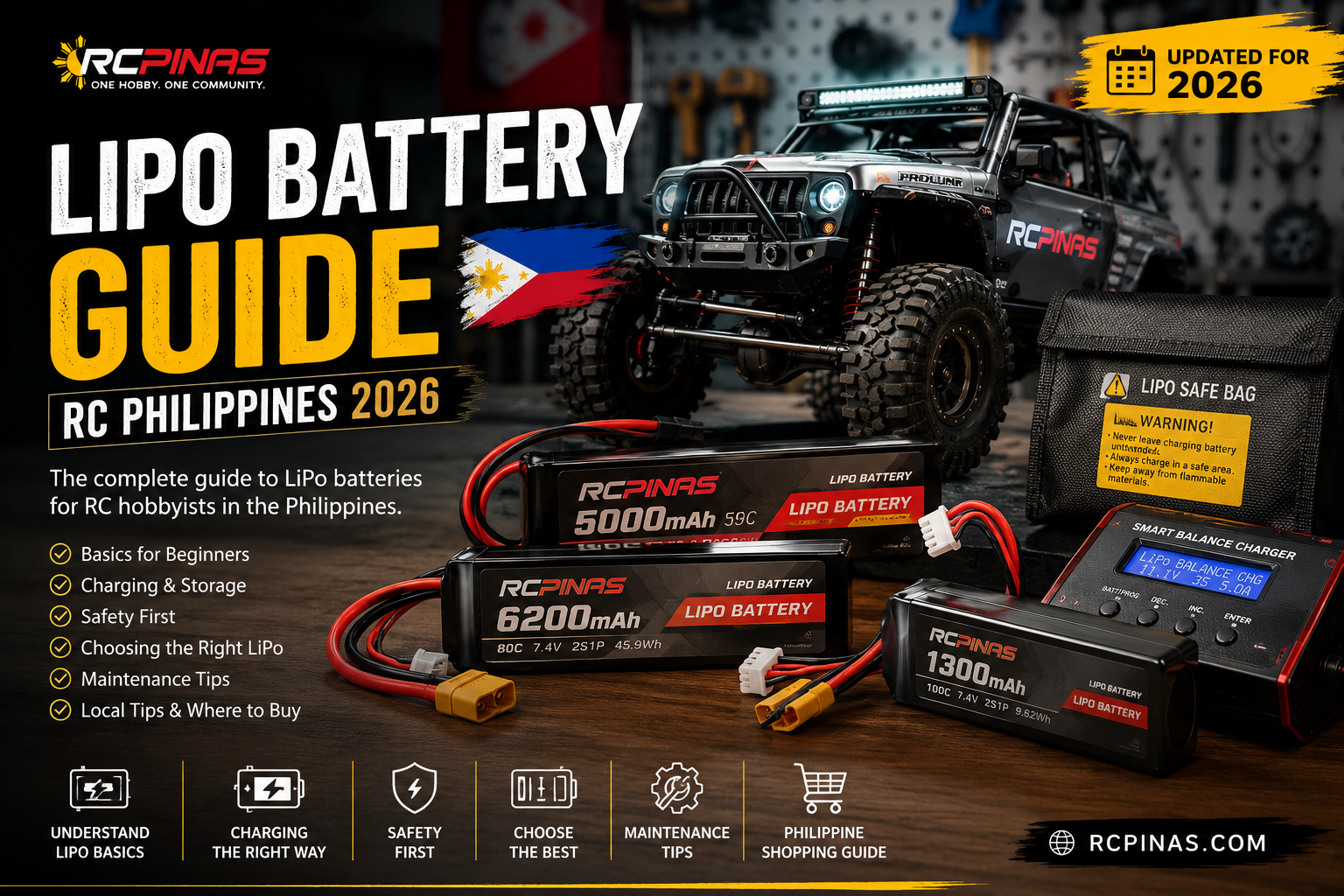
LiPo and Li-Ion batteries power every serious RC car, crawler, and basher in the Philippines today — but they work differently, suit different use cases, and need to be handled correctly to stay safe. LiPo chemistry delivers high burst power and remains the go-to for many racers and bashers. Li-Ion — particularly the 18650 and 21700 cylindrical cell format — has become the preferred choice for Filipino crawlers who want longer runtime and safer chemistry, and is increasingly used in custom high-performance basher packs too. This guide covers both: specs, safety rules, how to charge correctly, how to store in Philippine heat and humidity, where to buy quality packs, and when to retire a damaged cell.
Understanding LiPo Battery Specs — Cell Count, Capacity, and C-Rating
What LiPo Means
LiPo stands for Lithium Polymer. Unlike older Nickel-Metal Hydride (NiMH) batteries, LiPo cells use a lithium-salt electrolyte suspended in a polymer gel — which allows them to be made in flexible, lightweight pouches rather than rigid cylindrical shells. The result is a battery that is lighter, more energy-dense, and capable of delivering much higher burst currents than NiMH. For RC cars, this translates directly into faster acceleration, higher top speeds, and longer runtime per gram of battery weight. The tradeoff is that LiPo chemistry is more sensitive to overcharging, over-discharging, physical damage, and heat — all of which matter significantly in Philippine conditions.
Cell Count — 1S, 2S, 3S, 4S, 6S
Each LiPo cell has a nominal voltage of 3.7V, a fully charged voltage of 4.2V, and a minimum safe discharge voltage of 3.0V per cell. The "S" number tells you how many cells are wired in series:
- 1S (3.7V nominal) — Entry-level micro crawlers, mini RC cars, and small FPV drones. Not typically used in full-size RC cars.
- 2S (7.4V nominal) — The most common starting point for beginner to intermediate RC cars, bashers, and light crawlers. Easy to handle, forgiving on electronics.
- 3S (11.1V nominal) — Intermediate to advanced RC cars, faster bashers, and touring cars. Requires electronics rated for 3S and up.
- 4S (14.8V nominal) — High-performance RC cars, serious crawlers running competition-grade setups, and advanced bashers. More power, more heat, more responsibility.
- 6S (22.2V nominal) — Pro-level racing and high-power builds. Not a beginner configuration. Demands quality ESCs, motors, and wiring rated for extreme current.
Most Filipino RC hobbyists running crawlers, short-course trucks, and bashers will find themselves in the 2S to 3S range for daily use. Check your ESC and motor specifications before upgrading to a higher cell count — running 3S into a 2S-only ESC is a fast way to destroy expensive electronics.
Capacity — mAh and Runtime
The capacity rating in milliamp-hours (mAh) tells you how much energy a LiPo can store, which directly determines runtime. A 5000mAh 2S pack holds more energy than a 3000mAh 2S pack — it will run longer, but it also weighs more and costs more. For RC cars, common capacity ranges are:
- 2000–3000mAh — Lighter and smaller packs for mini and micro vehicles, or for hobbyists who prioritize handling over runtime.
- 4000–5000mAh — The sweet spot for most 1:10 and 1:8 scale RC cars. Balances weight, runtime, and cost.
- 6000–8000mAh — Long-session bashers and crawlers that need 45+ minutes of runtime without a pack swap.
In practice, Filipino hobbyists running bashing sessions at parks or trail runs at venues like Mudace RC Park should plan for 20–40 minutes of aggressive runtime from a 5000mAh 2S pack. Runtime varies significantly with driving style, terrain, and ambient temperature — which leads to the next critical spec.
C-Rating — Burst and Continuous Discharge
The C-rating indicates how fast a battery can safely discharge current relative to its capacity. The formula is: Max Current (Amps) = Capacity (Ah) × C-rating. A 5000mAh (5Ah) pack rated at 50C can theoretically deliver 250A continuously. Most LiPos also list a higher burst C-rating — the maximum current sustainable for a few seconds rather than continuously.
For RC cars, higher C-ratings mean the battery can supply the sudden current spikes that brushless motors demand during hard acceleration. Undersized C-ratings cause voltage sag — the battery's voltage drops under load, reducing power and heating the cells faster. A good rule of thumb for RC cars in the Philippines: choose a pack rated at 50C continuous or higher for bashers and performance driving. Crawlers, which draw lower sustained current, can use packs in the 25–40C range without issues.
Li-Ion Batteries for RC Cars — Runtime, Safety, and the 18650 Option
While LiPo has long dominated the RC scene, Lithium-Ion (Li-Ion) batteries have evolved far beyond what most Filipino hobbyists expect. They started as the crawling community's preferred option — longer runtime, more cycles, safer chemistry — but custom local builders are now producing Li-Ion packs rated at 240A–560A discharge that compete directly with LiPo in bashers and high-power builds. This is not your grandfather's 18650 flashlight battery.
Li-Ion vs LiPo — The Core Differences
Both chemistries share the same nominal voltage (3.6–3.7V per cell) and the same 4.2V full charge target, so they work with the same chargers and ESC voltage settings. The differences come down to form factor, discharge capability, and practical use:
| Feature | LiPo | Li-Ion |
|---|---|---|
| Form factor | Flat pouch / hardcase | Cylindrical cells (18650 / 21700) |
| Discharge (stock packs) | 25–100C burst | 5–25A per cell (standard cells) |
| Discharge (custom packs) | Up to 100C+ with parallel config | 240A–560A+ with high-drain cell config |
| Capacity per pack | High, flexible sizing | Very high — 6000–12000mAh+ in custom builds |
| Cycle life | 200–500 cycles | 500–1000+ cycles |
| Thermal runaway risk | Higher | Lower — harder to puncture, more stable |
| Runtime (2S 5000+mAh) | 20–40 min aggressive driving | 60–90 min crawling / longer than LiPo equivalent |
| Best for | Racing, bashing, high-power builds | Crawlers, trail runners — and custom high-power basher packs |
Li-Ion Cell Formats — 18650 and 21700
The numbers refer to cell dimensions in millimeters. An 18650 cell is 18mm diameter × 65mm long; a 21700 is 21mm × 70mm. Standard RC Li-Ion packs use cells wired in series, but custom builders wire cells in series and parallel to hit the capacity and discharge targets needed for each build:
- 2S Li-Ion (18650 × 2) — 7.4V nominal, typically 5000–7000mAh. The most popular Li-Ion setup for 1:10 scale crawlers. Long runtime, safe, lightweight.
- 2S Li-Ion (21700 × 2) — Same voltage, higher capacity per cell (4000–5000mAh each). Slightly larger, worth it for extended trail sessions.
- 3S / 4S / 6S custom packs — Built from premium high-drain or high-capacity cells (Tesla 2170, LG MJ1, Samsung) wired in parallel groups for massive discharge output. Local builders produce 3S 6000mAh, 4S 6000–12000mAh, and 6S 6000mAh packs rated 240A to 560A — purpose-built for bashers, truggy, and monster trucks.
Trusted Li-Ion Cell Brands for RC Use
Many RC hobbyists buy individual cells and have packs built by a trusted source. The cells the Philippine RC community trusts:
- Samsung 30Q (18650, 3000mAh, 15A) — The workhorse 18650 cell. Consistent quality, widely used in crawler packs.
- LG MJ1 (18650, 3500mAh, 10A) — One of the highest-capacity 18650 cells available. Excellent for scale crawlers and long-runtime trail builds. Used by quality local pack builders like Sassy Turbo Batteries.
- Tesla / Samsung 2170 (21700, 5000mAh, 10A) — The cell used in Tesla Model 3/Y battery packs. Extremely high capacity, reliable quality. Increasingly popular in custom RC packs for maximum runtime.
- Molicel P26A (18650, 2600mAh, 25A) — Higher discharge. Good for crawlers on technical terrain needing short power bursts.
- Samsung 40T (21700, 4000mAh, 35A) — More capacity and current than 18650. Popular step-up cell for performance packs.
- Molicel P42A (21700, 4200mAh, 45A) — Premium option. Li-Ion safety with LiPo-adjacent performance when configured correctly.
Avoid counterfeits. Rewrapped fake cells are everywhere on Shopee and Lazada. Buy from verified electronics suppliers or established RC hobby shops and custom pack builders who source genuine cells — like the local builders featured in this guide. A real Samsung 30Q costs ₱150–₱250 per cell. Quality custom pack builders also use Daly BMS (battery management systems) and pure nickel strips — not aluminum — which are signs of a properly built pack that will not fail under load.
Charging Li-Ion — Same Rules, Same Charger
Li-Ion charges the same way as LiPo: 4.20V per cell maximum, balance charging through your existing balance charger. The same ISDT, SkyRC, or iCharger units used for LiPo work perfectly for Li-Ion. Key points:
- Charge rate: Most 18650 cells are rated for 0.5C–1C. A 3000mAh cell at 1C = 3A. Some high-drain cells support 2C — check the cell datasheet and do not exceed the rated charge rate.
- Storage voltage: 3.7–3.8V per cell, same as LiPo. The storage function on your charger works for both chemistries.
- Minimum discharge: 2.5–3.0V per cell. Your ESC's LiPo low-voltage cutoff protects Li-Ion at the same threshold — no settings change needed in most cases.
- Partial charging is fine: No memory effect with Li-Ion. Top up a partially discharged pack anytime without issue.
In Philippine heat, Li-Ion has a meaningful advantage: Li-Ion cells are more thermally stable under moderate loads. They generate less heat during crawling sessions and are significantly harder to bring to thermal runaway — important for long summer trail sessions or home charging in a hot room.
Li-Ion for RC Crawlers — and Bashers Too
For Filipino crawlers, a 2S Li-Ion pack (18650 × 2, 5000–7000mAh) offers 60–90 minutes of crawling time per charge, excellent cycle life, safer chemistry, and voltage characteristics that most crawling ESCs handle identically to LiPo.
For bashers and high-power builds, the landscape is changing fast. Custom Li-Ion pack builders in the Philippines are producing packs rated at 240A–560A discharge — matching or exceeding LiPo burst performance while delivering higher capacity and longer cycle life. If stock LiPo packs are not lasting in your Traxxas X-Maxx, Arrma Kraton, or high-power build, a custom Li-Ion pack from a trusted local builder is worth investigating.
The main constraint: Li-Ion packs based on 18650/21700 cells are larger in diameter than LiPo hardcases. Measure your battery tray before committing to a Li-Ion build.
Choosing the Right Battery for Your RC Car
Whether you go LiPo or Li-Ion, match these three things to your vehicle's specifications:
- Voltage (cell count) — Must be within the range your ESC is rated for. Check the ESC manual.
- Physical size — LiPo packs vary significantly in dimensions. Measure your battery compartment. A 5000mAh 2S hardcase may not fit where a 5000mAh 2S softcase fits.
- Connector type — XT60 is now the standard for most RC cars. Older vehicles may use Deans (T-plug) or Tamiya connectors. Adapters exist but add resistance; re-soldering to a matching connector is cleaner.
For scale crawlers — the most popular RC discipline in the Philippines — a 2S 5000–6000mAh LiPo is the standard starting point, but a 2S Li-Ion 18650 pack (5000–7000mAh) is worth serious consideration if your tray fits it. Crawlers prioritize runtime and controlled power over raw speed, which plays directly to Li-Ion's strengths. If you stay with LiPo, choose a mid-C-rated pack from a quality brand over any cheap high-C claim from an unknown Shopee seller.
For bashers and short-course trucks, step up to 3S if your electronics support it. The power increase is dramatic, and a quality 3S pack from Gens Ace or Tattu will last hundreds of cycles when treated correctly.
LiPo Safety — The Rules Every Filipino RC Hobbyist Must Know
LiPo fires are real. They are intense, fast-moving, and cannot be extinguished with water. A compromised LiPo cell venting flammable gas can escalate to a thermal runaway in seconds. In the Philippines, where wooden structures and close-quarter living spaces are common, a LiPo fire is particularly dangerous. These rules are non-negotiable:
Never Leave Charging LiPos Unattended
This is the single most important rule. The majority of LiPo fires happen during charging. Stay in the room. Keep a fire extinguisher (or a bucket of sand) nearby. Do not start a charge cycle and go to sleep, leave the house, or step away for more than a few minutes.
Always Charge in a LiPo-Safe Bag or Fireproof Container
A LiPo-safe bag is a pouch lined with fireproof material designed to contain a thermal runaway event — it will not stop a fire, but it slows the spread and gives you time to move it safely. Charge inside the bag, store inside the bag, transport inside the bag. These are available from local hobby shops and online for ₱200–₱500. It is the most cost-effective safety investment in the hobby.
Signs of a Damaged or Swollen LiPo
Inspect your packs before every charge and after every run:
- Puffing or swelling — The most obvious warning sign. If a cell is visibly bloated or the pack no longer sits flat, it has begun venting gas internally. Stop using it immediately.
- Voltage imbalance between cells — A significant difference in cell voltages after charging (e.g., one cell at 4.19V while another sits at 3.95V) indicates a degraded cell. A good charger will flag this during balance charging.
- Extreme heat after a run — Some heat is normal. A LiPo that is burning hot to the touch after a moderate session is being pushed past its limits.
- Rapid voltage sag under load — If your RC car feels sluggish and the battery voltage drops sharply during driving, the pack is degraded and should be retired.
- Physical damage — Any puncture, deep dent, or torn wrapper. Do not use a physically damaged LiPo under any circumstances.
What to Do If a LiPo Catches Fire
Do not use water. Water reacts violently with burning lithium. The correct response:
- If the pack is in your charger or bag and you can do so safely, move it outside immediately — away from structures, vehicles, and fuel.
- Smother with dry sand or dirt. This deprives the fire of oxygen without reacting with the lithium.
- A Class D fire extinguisher (designed for metal fires) is effective but expensive. A 5-kg bucket of sand kept near your charging area costs nothing and works.
- Let the pack burn out fully if it cannot be safely moved. Do not throw water on it at any stage.
- Ventilate the area — burning LiPo releases toxic fumes. Do not inhale the smoke.
Disposing of Dead LiPo Batteries in the Philippines
LiPo batteries cannot go in regular trash. The correct procedure: fully discharge the pack to 0V over several days using a salt-water discharge method (submerge in a bucket of salty water for 2–3 weeks), then dispose at an electronics recycling point. Some local government e-waste collection drives accept LiPo batteries. Check with your barangay or city hall's environment office. Never puncture, incinerate, or throw swollen packs in household garbage.
How to Charge LiPo Batteries Correctly
Balance Charging — Always
There are two ways to charge a LiPo: normal charging (just the main discharge leads) and balance charging (normal leads plus the balance plug connected). Always balance charge. Balance charging monitors each individual cell and tops them off to exactly 4.20V per cell, preventing individual cells from being overcharged while others sit low. Normal charging only monitors total pack voltage, which can mask serious cell imbalances. The time penalty for balance charging is small — the protection it provides is enormous.
Recommended Chargers for Filipino Hobbyists
Your charger is as important as your battery. Cheap chargers with no cell monitoring or inaccurate voltage cutoffs are a fire risk. These are the chargers the Philippine RC community trusts:
- ISDT Q6 Plus / SC-620 — Compact, affordable, and highly accurate. The most popular entry-level quality charger in the local scene. Around ₱1,500–₱2,500.
- SkyRC D100 / D200 — Dual-output charger for charging two packs simultaneously. Popular with hobbyists who run multiple packs per session. ₱3,000–₱5,000.
- iCharger 308DUO / 406DUO — Professional-grade chargers used by serious racers and crawlers who want the most accurate and fastest charging available. ₱6,000 and up.
Avoid generic chargers sold as bundles with off-brand batteries on Shopee. A ₱200 charger has no place near a ₱2,000 LiPo pack.
The 1C Charge Rate Rule
The safest charge rate for any LiPo is 1C — that is, 1 amp per 1000mAh of capacity. A 5000mAh pack charged at 1C = 5A charging rate. This is the standard recommendation for maximizing pack longevity and minimizing heat buildup during charging. Most quality packs from Gens Ace and Tattu support 2C charging (10A for a 5000mAh pack) without damage, which halves your charge time — but generates more heat. In Philippine ambient temperatures, stick to 1C charging wherever possible. The heat reduction alone extends pack life significantly.
Storage Voltage — 3.8V Per Cell
If you will not be running your RC again within 24 hours, put the pack into storage mode on your charger. Storage voltage is 3.8V per cell — lower than fully charged (4.2V) but higher than fully discharged. Most quality chargers have a dedicated storage charge/discharge function. This is the most impactful thing you can do for long-term LiPo health, and it is especially critical in the Philippines where sessions are often weekly rather than daily.
Storing LiPo Batteries in the Philippine Climate
The Philippine climate presents two major challenges for LiPo storage: heat and humidity. LiPo cells degrade faster at elevated temperatures — and at 32–38°C ambient in Metro Manila and most lowland cities during summer, an RC bag sitting in a car or a closed room can easily see 45°C+ interior temperatures. Combine that with the rainy season's 80–90% relative humidity, and poorly stored LiPos degrade in months rather than years.
The Rules for Philippine LiPo Storage
- Never store fully charged. A fully charged LiPo (4.2V/cell) sitting for weeks causes cell oxidation and capacity loss. Always bring to storage voltage (3.8V/cell) first.
- Never store fully discharged. A LiPo left below 3.0V/cell for extended periods can enter a deeply discharged state that some chargers will refuse to charge — and that is genuinely dangerous to attempt to revive.
- Store in a cool, dry location. Indoors, air-conditioned if possible, away from direct sunlight. An air-conditioned room at 22–25°C significantly extends LiPo lifespan compared to a hot bodega or car trunk.
- Use silica gel packs inside your storage bag. During the rainy season, humidity can get into battery contacts and wiring. A few silica gel packets inside a sealed container with your LiPo packs absorb excess moisture.
- Check voltage every 1–2 months. Packs sitting in storage slowly self-discharge. If a pack has dropped well below 3.8V/cell after a month of storage, it may have a weak cell. Check with your charger and top up to storage voltage.
- Never store LiPo in a vehicle. Car interiors in Philippine sun routinely reach 60–70°C. This will puff cells and permanently degrade capacity, even if the pack does not catch fire.
Generator Charging Concerns
During brownouts — a regular reality in many parts of the Philippines — some hobbyists charge using generators. Generator power output can be noisy and voltage-inconsistent, which can cause problems with sensitive charger electronics. If you must charge on generator power, use a charger with wide AC input voltage tolerance (look for 100–240V AC input), and avoid high charge rates that stress the generator under load. A quality charger like the ISDT or SkyRC units will handle generator power better than budget chargers with narrow voltage tolerances.
Where to Buy Quality LiPo Batteries in the Philippines
Trusted Brands
Buy from established brands with verifiable reputations. The Philippine RC community's most trusted LiPo brands are:
- Gens Ace — The most widely used quality brand in the Philippine RC scene. Consistent capacity, accurate C-ratings, good cycle life. Available from multiple local hobby shops and online.
- Tattu — Made by the same manufacturer as Gens Ace, positioned at performance-level users. Popular with FPV and high-performance RC racers.
- SMC (Speed Master Cells) — American brand with a strong reputation for accurate C-ratings. Less common locally but available through import.
- Spektrum — Reliable and widely available through official hobby distributors. More expensive than Gens Ace but well-supported.
- Venom — American brand with solid quality control. Increasingly available through local shops.
What to Avoid
The Philippines' Shopee and Lazada markets are flooded with no-brand LiPo packs marketed under names like "Ultra Power," "Power Hobby," and other generic labels — often with wildly inflated capacity and C-rating claims. A pack claiming 100C discharge at 5000mAh for ₱350 is not delivering what it promises. These packs have:
- Overstated capacity (actual tested capacity is often 60–70% of the stated rating)
- Poor cell matching, leading to rapid imbalance
- Thin wiring that cannot handle the stated current
- No quality control — puffing within 20–30 cycles is common
- Genuine fire risk from substandard separator materials
The ₱800 you save on a fake 5000mAh pack will not cover the cost of the ESC or motor it damages when it voltage-sags under load — much less the property damage if it decides to vent during charging.
Checking Authenticity
Quality brands like Gens Ace and Tattu have authenticity QR codes on their packaging. Scan the code on the pack before your first charge. Buy from physical hobby shops or verified online sellers rather than random Shopee listings. If the price looks too good compared to other listings, it is almost certainly not genuine.
Price Ranges in the Philippines (2026)
- 2S 5000mAh 50C (Gens Ace) — ₱1,800–₱2,500
- 3S 5000mAh 50C (Gens Ace) — ₱2,500–₱3,500
- 4S 5000mAh 50C (Tattu) — ₱3,500–₱5,000
- Quality charger (ISDT Q6 Plus) — ₱1,500–₱2,500
- LiPo-safe bag — ₱200–₱500
For Filipino hobbyists looking for a trusted local source for quality LiPo batteries, chargers, and accessories, Jac's RC Crawler is a verified RCPinas community partner with a strong reputation in the crawling community. They stock quality brands and can advise on the right pack for your specific rig — something no Shopee listing can offer. Supporting local hobby shops keeps the Philippine RC community healthy and gives you a reliable point of contact when something goes wrong.
Extra.Rys Power Solutions is a trusted local source for LiPo and Li-Ion battery packs in the Philippines, catering to the RC hobby community. Whether you need a quality LiPo for bashing or a custom Li-Ion pack for your crawler build, Extra.Rys has the expertise to point you to the right solution for your rig.
Ace Robotics and Batteries specializes in customized Lithium-Ion battery packs built for high-performance RC vehicles. Their Basher RC Series packs are engineered for maximum discharge — 3S 6000mAh at 240A, 4S 12000mAh at 560A, 6S 6000mAh at 280A — individually tested before sale, built with premium-grade cells, and compatible with bashers, rally, truggy, monster trucks, and any high-power RC application.
- Custom Li-Ion packs: 3S / 4S / 6S configurations available
- Individually tested before sale — stable, reliable performance
- Built with premium quality cells — comes with warranty
- Compatible with basher, rally, truggy, monster truck, and all high-power RC builds
Sassy Turbo Batteries builds custom Li-Ion battery packs using genuine Tesla/LG MJ1 and Samsung cells — not rewrapped fakes. Every pack is assembled with Daly BMS protection, pure nickel strips, and top-of-the-line equipment, giving you a safe, reliable, and high-performance power source for your RC build. Based in Marikina City, they serve the Philippine RC community with packs built to a standard you can trust.
- Genuine Tesla / LG MJ1 cells and genuine Samsung cells — no fakes
- Daly BMS — overcharge, over-discharge, and short circuit protection
- Pure nickel strips (not aluminum) for maximum conductivity and reliability
- Built with top-of-the-line equipment in Marikina City, Philippines
Signs Your LiPo Needs to Be Retired
No LiPo lasts forever. The average quality pack gives 200–500 full cycles before noticeable degradation — but Philippine heat and humidity accelerate aging. Retire a pack when you see:
- Visible puffing or swelling — Any amount. There is no safe level of puffed LiPo.
- Capacity below 80% of rated — If your charger shows the pack only takes 4000mAh when it is rated 5000mAh, you have lost 20% capacity. Usable but monitor closely. Below 70%, retire it.
- Persistent cell voltage imbalance — If the balance charger consistently shows large cell-to-cell differences after charging, one cell is dying. Retire the pack.
- Excessive heat during normal use — A healthy pack should be warm but not burning hot after a run at moderate current. Extreme heat means internal resistance has increased — the pack is converting energy to heat instead of power.
- Rapid voltage sag — If your RC car's power drops noticeably within the first few minutes and comes back at rest, the pack's internal resistance is too high. It is time to retire.
When retiring: follow proper disposal procedures described above. Do not give a swollen or degraded pack to someone else thinking you are doing them a favor. Retire it safely.
Frequently Asked Questions — LiPo in the Philippines
Can I charge my LiPo during a brownout using a power bank?
No. Consumer power banks output 5V USB power and cannot charge RC LiPo packs, which require balance charging through dedicated charger inputs. A proper field charger connected to a 12V car battery or a stable generator is the correct approach for off-grid charging. Do not attempt to charge LiPo packs through improvised methods.
How long can I store a LiPo at storage voltage (3.8V) before I need to check it again?
A quality LiPo at storage voltage in a cool environment should be fine for 1–3 months without a check. In Philippine conditions — especially during the humid rainy season or if stored in a room without air conditioning — check and top up storage voltage every 4–6 weeks. Do not leave packs unchecked for more than 3 months.
My LiPo puffed after only 10 cycles. Is it defective?
Puffing within 10 cycles typically indicates one of three things: the pack was overcharged (charger fault or wrong voltage setting), it was discharged too deeply (over-discharged below 3.0V/cell), or it is a poor-quality pack with substandard cell materials. Quality packs from Gens Ace or Tattu should not puff within the first 10 cycles under normal use. If you bought from a trusted source and followed correct charging procedures, contact the seller — but if you bought from an unverified Shopee listing, this is the expected outcome for counterfeit packs.
Is it safe to fly with LiPo batteries on Philippine domestic flights?
Philippine aviation regulations follow IATA guidelines: LiPo batteries for personal use are generally permitted as carry-on only (not checked baggage), below 100Wh without airline approval and 100–160Wh with airline approval. Batteries above 160Wh are generally prohibited. Most RC LiPo packs fall in the 37–160Wh range depending on cell count and capacity. Always declare them at security, keep them in LiPo-safe bags, and check the specific airline's policy before traveling — Cebu Pacific and Philippine Airlines have slightly different specific procedures.
Can I revive a deeply discharged LiPo that my charger refuses to charge?
In some cases, a quality charger with a "recovery" or "rejuvenate" mode can bring a deeply discharged pack back to a chargeable voltage — but this carries risk. A pack that has gone below 2.5V/cell for an extended period has likely suffered permanent cell damage. Even if revived, treat it as a degraded pack: test it carefully, watch for heat and puffing, and be prepared to retire it quickly. Never attempt to revive a pack that shows physical damage or puffing.
Should I use LiPo or Li-Ion for RC crawling in the Philippines?
For most Filipino crawlers, Li-Ion is worth serious consideration. A 2S Li-Ion 18650 pack delivers 60–90 minutes of crawling time per charge versus 20–40 minutes from a comparable LiPo, lasts 500–1000+ cycles versus 200–500 for LiPo, and carries safer chemistry for home charging and transport. LiPo remains the better choice for performance racers where burst power matters most. For bashers, custom Li-Ion packs from Philippine builders like Ace Robotics and Batteries are now hitting 240A–560A discharge — meaning Li-Ion vs LiPo for bashing is no longer a one-sided conversation. The practical constraint is physical fit — measure your battery tray to confirm it can accommodate 18650-diameter cells before committing to a Li-Ion build.
What is the difference between a hardcase and softcase LiPo? Which is better for RC cars?
Softcase LiPo packs use the original flexible polymer pouch — lighter and slightly more energy-dense, but vulnerable to puncture and physical damage. Hardcase packs enclose the cells in a rigid plastic shell — heavier but much more resistant to the impacts and vibration of RC car use. For Philippine trail crawling and bashing where packs take knocks regularly, hardcase LiPo packs are strongly recommended. The weight penalty is minimal in a 1:10 scale car, and the protection against puncture from crashed rocks or hard impacts is significant. Check that the hardcase dimensions fit your vehicle's battery tray before ordering.
The Bottom Line
LiPo and Li-Ion batteries have both transformed the Philippine RC hobby — and neither is going anywhere. LiPo remains dominant for its raw power and pack variety. Li-Ion has evolved from a niche crawler battery into a legitimate option for high-power builds, with local Filipino builders proving that custom Li-Ion packs can deliver 240A–560A discharge while lasting twice as many cycles. The right choice depends on what you drive and how you drive it.
In either case, the rules are the same: buy quality, charge correctly, store at 3.8V, and inspect regularly. In the Philippines, managing heat and humidity in your storage routine is genuinely important — not optional. The cost of a good charger and a LiPo-safe bag is trivial compared to a battery fire or prematurely dead pack. The Philippine RC hobby is growing fast — help keep it safe for everyone by setting the right example.
Looking for other RC maintenance guides? Read our full breakdown of RC repair in the Philippines and finding a trusted technician, or explore the best RC cars to buy in the Philippines in 2026 to find your next rig. For quality LiPo batteries and chargers from a trusted community partner, visit Jac's RC Crawler.
- RC ESC Guide Philippines — Best Speed Controllers for Crawlers, Bashers & Drifters
- RC Repair in the Philippines — Finding a Technician & Basic Maintenance Tips
- RC Crawler Tire Compound Guide: JConcepts Green vs Pro-Line G8 vs Predator
- Best RC Cars in the Philippines 2026 — Buyer's Guide by Budget
- RC Motor Guide Philippines 2026 — Brushed vs Brushless, KV & Best Motors
- RC Servo Guide Philippines 2026 — Best Servos for Crawlers, Bashers & Drifters